
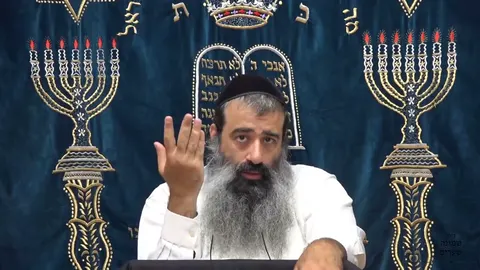
אור החיים מול כוח הספק 10

19.4.20240:39:27וידאו ושמע
הורדה
- וידאו · 1080p · גבוהה980 MB · העותק מיוטיוב
- וידאו · 1080p · בינונית974 MB · קובץ המקור
- וידאו · 1080p · בינונית974 MB · קובץ המקור
- וידאו · 1080p · בינונית937 MB · קובץ המקור
- וידאו · 1080p · רגילה894 MB · העותק מיוטיוב
- שמעMP3 · 54.2 MB
- שמעMP3 · 54.2 MB
- שמעMP3 · 36.1 MB
- שמעMP3 · 54.2 MB
- שמעMP3 · 54.2 MB
נקרא גם: 10 אור החיים מול כוח הספק · אור החיים מול כוח הספק 10 הכניסה לעולם הקבלה הרב מאיר מועלם
על השיעור
כולל "שמונה שערים" בראשות הרב מאיר מירון מועלם שליט״א תרומות לכולל ולהפצת התורה ניתן להעביר: פייבוקס/ביט: 054-8028566 קישור לתרומה:https://secure.cardcom.solutions/e/xyy3 לעמותה סעיף 46 להחזר מסלהצגת התיאור המלא
כולל "שמונה שערים" בראשות הרב מאיר מירון מועלם שליט״א תרומות לכולל ולהפצת התורה ניתן להעביר: פייבוקס/ביט: 054-8028566 קישור לתרומה:https://secure.cardcom.solutions/e/xyy3 לעמותה סעיף 46 להחזר מס
Hello everyone. We are continuing the introductory lesson to the world of Kabbalah. We are still in the secret of the connection between Malchut and faith. We saw on the level of how, through faith, a person connects themselves to Malchut, and in this, they are connected to the 10 Sefirot from which Malchut receives, and in this, they are connected to His blessed essence. Let's try to explain this a little, and then try to understand the matter of faith a bit more. We said that all the activity of thought, of man's contemplation, rests in the end
on faith, which means there is a reality of faith in Him, blessed be He, which will always be in the end in the category of faith and not in the category of knowledge. That is to say, His essence, blessed be He, cannot be known. Therefore, we always turn to Him in the secret of faith. Meaning, this will always be in the realm of faith. We can, a person can experience His providence, blessed be He, in the world , feel Him. Uh, one can really acquire clear knowledge in their faith, that the Holy One, blessed be He, is with them, but every orientation of ours towards Him, blessed be He, is in the
realm of faith. Meaning, no matter how high a person is, when they come to pray, they come to pray. Ultimately, the prayer turns to a reality of infinity, no grasp, surrounding light, and like, in some place, to something unknown, but not that it is entirely unknown, something that you have a deep connection in your heart to, to a supreme good, but still lacking attainment. In contrast, a type of, a turning in the secret of faith that will always be in the aspect of faith, because our perception will always be limited to our form. And our form, which is the human form, will never be able to grasp something different from its own form, and therefore it will always encounter the Name, blessed be He, according to its form. But the, my
meeting, a meeting with the Name, blessed be He, that is the emphasis, that is what Kabbalah wants to give. That, even though there is a question: the Ramak asks, that we say the name Havayah, so how can we say it? How can we say the name Havayah upon Him? After all, the name Havayah cannot apply to Him, yes, it doesn't apply to Him in terms of. In terms of the principles of faith, no name, no letter, nothing can apply to Him. And with the Rambam, for instance, it is a foundation: nothing, no attribute, nothing can grasp or apply to Him, but He is simply absolute . So how do we say the name Havayah? The Ramak says, if you say that we say the name Havayah upon Him because He constitutes everything, that His existence is eternal, so he says, regarding Him being "He-Who-Is," Havayah from the root "present," so he tells him, "You haven't said anything,
you haven't added anything, there is no matter in this. Because you could have started saying, instead of the name Havayah, the name" Exists. "You are only coming to state the matter and the idea that He is present, that He exists , that He is found, that He is eternal, but you didn't bring in...There isn't in His name anything that is truly of special holiness that tries to point to Him, but rather a description that He is always existing and eternal. So what is so holy about the name Havayah? You mean existence. That is why the Ramak is trying to tell us that within the reality of the name Havayah, there is truly, from the side of...of...of its true revelation, a supreme holiness in this name. On one hand, the Ramak says you cannot attribute this name to Him. On the other hand, it does not just come to express to us that He exists and is present, but in truth has no relation to Him, rather there must be something in this name that does apply to Him, but does not truly apply to Him
. In other words, what is this? It is like a dilemma: What do you mean it applies to Him and doesn't apply to Him ? Either it applies to Him, or it doesn't apply to Him. Because if it says, if it applies to Him, then it is truly coming to describe Him—and He cannot be described. And if it doesn't apply to Him, then it doesn't apply to Him, so what is the difference between it and another name? But the answer is: It applies to Him in the way that I perceive Him. Not just me, I as a created being, as if every created being—it doesn't matter, even the highest created being—in that way, it applies to Him. Meaning, it applies to Him according to the form of the created being. The form of the created being that encounters His revelation, blessed be He, is how he encounters it. In other words, the name Havayah is actually...so to whom does it belong? To the created being or to the Creator? If it is according to the form of the created being, then it is as if it belongs to the created being. But in truth, it belongs to the created being because he encounters Him, so it belongs to the Creator. That is to say, from what side does it belong to both of them together? Meaning, it actually expresses the connection between the
reality of His revelation and our perception. And that is why the Ramak says: The name Havayah is the foundation of all actions. After all, the Holy One, blessed be He, is revealed only through His actions; it is like a king who is revealed in his kingdom only by his deeds. So, so, so again, we are like subjects who believe there is a king in this kingdom, but what we encounter in the kingdom are the actions. So all the actions that are in creation, all the Sefirot, all the names, all the titles—and there are many—all of them ultimately concentrate into the secret of the name Havayah, as Rabbi Yosef Gikatilla did in the book called Sha'arei Orah, where he tried to show how all the Sefirot, all the titles, all the names, everything he could include, all the epithets, fit into the four letters which are the essence of the name. He really did great work in that book, although one could say much more beyond
what he said. A lot, a lot, a lot. Just on every letter of the name Havayah one could make, I don't need books, just like that, just to open and open, to open and open and explain, and if this, what it means, and if this, what it means, because the name Havayah ultimately feeds all the actions entirely. On the other hand, the Ramak tells us explicitly: and He, blessed be He, has no action at all; all actions proceed from Him. This is the Name Havayah, and He has no action at all. So what does it mean that He has no action? Rather, the activity that is with Him is called absolute activity. I explain this according to our intellect : it is perceived by us partially according to what we can grasp, and this partial reality, which is not partial in Him but partial because of us, is ultimately revealed to us in the secret of the Name Havayah. In other words, the Name Havayah is actually the
connection, let's say it is our way of contemplating Him, and therefore I do not perceive only actions. It is true that these are actions, but they are not just actions; it is not that I am discovering actions in the world, no, I am discovering His actions. Understand? It is much stronger than saying actions , the basis of actions, many actions. It does not come to reveal actions to me, it reveals to me as if He is acting for me—not for Him. That is why I call it the Noun (Name of Essence), that is why I attribute it to Him. That the entire reality of the Name Havayah is everything, it ultimately constitutes the connection between me and Him. It is actually as if the nine sefirot between Malchut, because what is it? It is the actions that are revealed in Malchut, it is as if the nine sefirot between Malchut and Him, it is the bond between me and Him, the bond that is in the middle. Therefore, ultimately the reality of the Name Havayah is a product of both of us, that we need to understand more what
this revelation of actions is, what this contemplation called faith is, whether it is study of Kabbalah, whether it is something beyond that, whether it is something that I also need to activate from myself. After all , one must understand, understand this great foundation. It turns out that the Name Havayah is actually, in a certain sense, the form, the Divine revelation of the human form. Because if I say that these actions are revealed, it is not that the Holy One, blessed be He, chooses to reveal these actions for me, for if not, it would be a change that now He chose this way and before He chose differently, but rather because of the way my form and my activity are, this is how He is revealed. So, in fact , this is how He is revealed, not that something is revealed within me. That is to say, no Name Havayah would be revealed in me if it depended only on
me. It is His revelation within me. But it is His revelation. And Therefore we must understand that there is a connection—it is not even just a deep connection, it is an absolute connection between the Name Havayah and us. Because we ultimately cause the revelation to appear this way. And therefore we must recognize—notice the depth of this—we must recognize, in order to really know how to enter the world of Kabbalah, we must recognize the Name Havayah within us. We must recognize the Name Havayah. Even though I say Name Havayah within us. And the Rabbi says that truly the Name Havayah is revealed in everything, even in a stone. Nefesh, Ruach, Neshama , Chaya, Yechida exist in every aspect. But to know it—meaning to know it in the fullest sense—we cannot, because these are things that have no end. But
to at least know the structure that exists within me, which is ultimately connected in the deepest way I can grasp today to the reality called the Name Havayah, which is its revelation in the world—then I can get closer and closer to the reality called Divinity, a reality called faith at its truest level. In other words, I can know the Name Havayah because I study it in a book. Is that what it means to know the Name Havayah? After all, it is written for us in Kabbalah that there is such a thing as the revelation of the Name Havayah in the world. Let's say in the World of Atzilut. As the Rabbi says in the chapters where he begins to speak about the Akudim, he says," The Lord swore by His Nefesh. " He explains that the Lord, which is the World of Nekudim, the World of Atzilut, swore by His Nefesh, which is the World of Akudim. Because anyone who swears, swears by someone who is higher and more elevated than themselves. And since the World of Akudim is higher than the World of Nekudim, the World of Nekudim—which is the World of Atzilut
—swore by the World of Akudim, which is above it. And why specifically by His Nefesh? Because the World of Akudim was revealed in the form of a Nefesh at the beginning of its emergence, and therefore the Tetragrammaton swore by His Nefesh. Meaning that it is as if the Havayah represents something to me, that it can as if swear by something higher, and in fact, what does it represent to me? Its revelation in the World of Atzilut. Why is it specifically attributed to the World of Atzilut? Why don't I say the Lord swore by His Nefesh, implying the World of Akudim is higher? Because the World of Atzilut already reveals the form of man . The structure of the World of Atzilut is already a structure that has Partzufim and has a revelation of limbs . In the Nekudim there was no revelation of limbs yet, and therefore there was a breaking. But at the time of the Tikkun, there was a revelation of limbs. Revelation of hair. The beard , the ears, the eyes, the nose, the mouth. All the rectifications were made . And then the Adam of Atzilut was created for me. Above that, there was also, but it was concealed, I could not speak in terms of vessels. Adam Kadmon is also an Adam. That is why he is
called Adam. But Adam Kadmon is truly a root reality of Adam. And with the root , you cannot speak. Even the first vessel that was created for Adam Kadmon , which is outside of him, which is the World of Akudim, is a vessel that is not yet complete. And why is it called Akudim? Because all the lights that came out from the mouth of Adam Kadmon are found within one vessel. So the shape of the vessel cannot truly express the structure of the lights, because they are bound. That is why they are called Akudim; Akudim means bound, they are tied and bound in one vessel. And therefore the form of Adam cannot truly be revealed there. And therefore the lights in the World of Akudim are in one line—the lights in the World of Akudim are in one line, they are not in three lines—to tell us that the form of Adam still cannot be revealed there. Even though the word Adam exists in Adam Kadmon, it is only in the highest, most high, the hidden highest root. But in truth, the revelation of the form of man is when vessels are already formed, and these vessels stand in the mystery of three
lines, in thickness, in length, in infinite expansion, which we call the World of Atzilut. But in truth, what is special about the fact that something called the" Man of Atzilut "was revealed in the world? And then I can say" the Name, "I can say the Name YKVK . Why? Because then the Name of God is revealed in its clearest form, which is found in the revelation of the World of Atzilut. Therefore, we must now understand: what we need to understand in our lesson is more and more the connection between the reality called the Name of God and what it means that I am calling it the Name of God, more through intellect and more through understanding. To understand this, we need to understand what is more, what is faith. To understand faith better,
we will read a little from Maimonides in the Guide for the Perplexed, Chapter 50, where he speaks about faith. And why? Because in faith, there is also a simple perspective on faith and a deeper perspective on faith. So he says as follows. Meaning, we need to ask such a question. Ultimately, we will see that the highest faith will be simple faith. But even saying" simple faith, "sometimes a person errs in it. In the concept of faith, and one must understand—let's say in simple terms: everyone feels simple faith and intends towards simple faith. But also in faith , since faith ultimately opens me up to a world of knowledge—within the doctrine of faith and within the study of faith, I need to know this, and that , and that, and that; and I have principles of faith and thoughts of faith—and then faith, hop, brings me into a whole world. True, before I entered this world, it was a world that seemed not to exist, but the moment I entered it—it actually created the
true spiritual world. Now, why is it a true spiritual world? Because it directs you to the spiritual thing which is truly truth, that you cannot grasp. Because I have within my own true reality two realities—this is what I wanted to say at the beginning —two realities that I can define as faith. Faith in what I do not grasp and I turn to, and faith also in what I do grasp. After all, within my reality, as knowledge, just as I know you, know the chair, know many things, this is also a mystery of faith, as we discussed in the first lessons, because even in this , I can what? I can cast doubt. But one must understand that there is a difference between faith and doubt. That I say that the world surrounding me, I cannot know it with certainty. I can only know that I grasp it, but I cannot know its true reality with certainty. I can understand that perhaps everything here is thought. I can understand, perhaps there really are objects here? Perhaps I can understand, maybe it is all in my head? I truly cannot know with certainty, but
I can know with certainty that since something is indeed revealed to me, it turns out that I turn to it in the mystery of faith. Because one must understand there is a difference between this and doubt, as one might think that we are casting the whole world into doubt, and that is what philosophy did. That is to say, philosophy in its great progression, and actually its great downfall as well , tried to transition between real knowledge (having always claimed to know everything, understand everything) and then it realized it cannot truly know everything. It realized it had to enter a world called faith, because one truly cannot know this; it cannot get out of the human, one cannot get out of oneself to clear knowledge regarding something one does not grasp, and then it realized it has doubt regarding reality. But what it did in the transition between faith, which is a faith of reality, to faith—sorry, between real knowledge and knowledge found within the reality of the human
himself—it cast all of reality into doubt, and then, from that casting of reality into doubt, it did not emerge from this doubt. It did not emerge from this doubt. Meaning, doubt is a great destruction of the entire world of philosophy. It was actually as if it were a great ascent in philosophy because it introduced it to a certain reality that says, oh, of this I can be doubtful, but other things I can be certain of. I have certainty regarding the" I, "regarding my thought, regarding all sorts of things. In the end, even that collapsed. And so it turns out that philosophy left itself —it's as if doubt was its great ascent and also its great destruction. Faith, from the outset, answers—it faces this reality. It speaks of reality directly. It says there is no such thing as such knowledge. You have faith. That is to say, in fact, faith is the war and the doubt. Faith is not doubt. In philosophical thought, it looks like: what is the problem? They already talked about this. You are simply casting doubt on reality. No. Faith does not come to say that. Faith
comes to say the opposite: I accept these principles, even those that philosophy spoke of, but it is not knowledge; it is still faith. I know it is faith, but I fight to know that it is true. That is to say, I have an internal war to declare that this thing is real. Understood? That is the difference. Meaning, faith comes from a place where it knows from the start that it is impossible to know. And that is the difference between it and philosophy. Philosophy comes with an approach that it already knows. So, because it knows, it only has to put things in order. It arranges this, it arranges that, everything is organized for it. The moment it realized it could not know, it crashed, because it wants to come with an approach of knowledge, but faith tells it from the outset: you cannot come with an approach of knowledge, you cannot, because it is a lie, because you cannot know it. You can tell yourself: here I see, here I understand; you can say it tomorrow, so what? That is not true. It will always be incorrect, because you can never really know it. You truly have no necessity for it, no proof, no basis,
and no certainty. You want it to be certain, you can cry for it to be certain, you can pray—it won't help you. It is an uncertain person, you cannot know it is certain; I cannot know for sure that you are here. Notice the difference between philosophy, knowledge, and faith. In philosophy, I can say, I see you, I cannot, so I cannot prove that you are here. At first they thought, it’s obvious you’re here, but actually, faith tells you, tells us, I cannot know you are here. I cannot, I cannot make you know that you are here. But what is the difference between that and philosophy? The philosopher will say: Because I am looking for knowledge, I say here, now I see a gray spot and that’s it, this I know. I know there is gray here, there is brown here, there are eyes here, there are glasses here, I know. After that, let’s say you went out, returned with a cup of coffee, again I know, there is gray here, there are eyes here, there are ears here, there are glasses here. Meaning, this is what ...go out, come back again, I know. In other words, it has no option other than to say what I know right now. It has nothing in faith. I say more than
that: I don't care that there is gray, eyes, ears, glasses here; I believe that you are here and I fight for it. That is what is meant by the war of God . Why is it a war? Because it is to fight against doubt. Doubt can always drag you into doubt. It has immense power because it simply tells you, listen, you cannot know. And this knowledge can penetrate everywhere, and it does penetrate everywhere. Whoever enters this place is in a bottomless pit. Because in every place you can say , cast doubt. Whoever understands this, this, this thing. But faith says, I knew from the start that such a thing exists, because I didn't come to the world with such an approach, but because of that I know that faith is that you are indeed here and the more I connect with you, the more the connection between us becomes real. Meaning faith from the start comes from a direction that it doesn't say there is knowledge. It comes from a direction of what? That I know that in my head
there is a picture and I want to connect this picture with reality and I do it. And the more I connect it more and more and more, I will discover more and more and more. Meaning no, why? Because in the philosopher's thought, in the end, he is left only with a gray spot in front of his eyes. If he writes a book, he writes about the spot, that’s it. Like, what happens with the spot? How should we speak about the stain? I mean, what, did he turn the world into a stain? But he doesn’t marry a stain; ultimately, he doesn’t live with a stain. Even that same stain , he sees it on the laundry all the time, he measures it, then puts it in the washing machine. He lives with this stain—it’s not a stain anymore, he sees it’s a garment. But he can't say anything other than" stain "because he must be true to what he sees. But through faith I will say: Fine, say what you want, meanwhile it is a garment, I live and wear it. Why are you telling me it's a stain? The fact is that it hasn't even disappeared to this day. That is to say, faith brings me life and tells me: Listen, it is clear that you cannot grasp life because it does not originate from you.
Since it does not originate from you, you must be a reality that you are a part of, based and partial—not just that. What faith also provides is an opening to ascend upward because it opens you to a reality that you can connect to, and from that, also not abandon the stain, and begin to understand that there is a root to faith and to rise toward the higher direction. It turns out that ultimately , what faith does is it connects the reality of existence with our thought. It connects the reality of" my " existence with the vitality that is outside. My life with the vitality that is outside. That is, if I see in the end that the vitality—not the thought , the vitality within my soul— connects with other vitality, it will prove to me that there is a connection. It will prove it because it is already vitality. It is not a reality where I say," Wait, here is one, here is two,
do they connect? "No. The vitality itself, the desire within me, connected with another desire. The additional living desire will itself prove to me that it exists. Although I cannot know the essence, so what? But to live with it, and have from it elevation and connection, there will be consequences. There will be, meaning, this connection —it will produce life. Because it is not a connection between thought and thought, it is a connection between life and life. And once this life intermingles, your whole reality of life rises, because you connect to a higher reality of life. Then everything fills with life, so you no longer care about the doubt. Because you begin to see that the reality of life is expanding. It is no longer on my personal level. It is not inside my thought. This is not a form of observation at all. It is a reality that suddenly reveals itself to me. In other words, the spiritual revelation, the revelation of the Name of God in
the world, actually reveals to me that there is truly a reality in the world. But it is an internal reality called life. Because life cannot, cannot act against nothing. The moment that life meets life, the second life compels it. Meaning: the necessity, the reality standing before you, I am now ultimately forcing you to know that I am here. You are, in a way, unable to really doubt this, because lives meet, and they meet at such a depth that they fill and unite the reality of two together. Do you understand? It is a kind of unity that once you are in it, you have already forgotten what the reality of doubt even is, because that is not where the reality of faith is, it is in the reality of true connection and not in the reality of simple intellectual connection. It depends on what society you are in, it depends on what society you are in, if you. Not addicted, also a person on the
street, cold or not cold, like. True, true. Because by human nature he lives normally. It’s like if you were to take a cat now, yes, a cat. A cat is more believing than many other people who have doubt. It sees you, it knows you are a human being. It doesn’t start thinking: wait, are you here, or not here? Previously, you are black, you are white, you...even if it doesn’t grasp your form immediately, it lives with your form immediately. It has a constant, direct connection, in a way it is much more of a person than human beings. Because a person who doubts the other is already sick in terms of life, he is sick in terms of critical thinking. He is called healthy , as it were, but he lives in great sadness because he is locked in the prison of his own thought. Now, this prison is the strongest prison in the world; there is none stronger than it. A person who has a connection to life, put him in prison, in a dungeon, he is still alive, he is just inside a dungeon. But a person who has what I am
saying, who has what I am talking about , this doubt, he is in prison. If you put him in the busiest society of people with the greatest joy, he is in prison. Now more than that, he will also be sad that he cannot enjoy this joy. It is a prison within the reality of the person and it is a strong, firm prison. A cat doesn’t have this, It is connected there, and a child doesn’t have it either. As one matures, the joy of life decreases and this place begins to strengthen. Why? Because many principles in secular society permeate. If a person studies what secular society is based on in terms of thought , he will understand that it sits on a mindset of doubt. The mindset of secularism did not come out of nowhere; it was built after many failures of philosophy. Philosophy and its failures shaped the mindset you live in. Now, it
is true that we, thank God, have the strength to stand against this place, but ultimately there is nothing to say: its arms, the arms of doubt, are strong ; they enter, they have work to do. But we, we still have someone who comes with a world that has vitality, they stand before this place, because simply , in a human's natural state, there is, they do not accept this place. Yes? So, once again, let us return to our subject. You simply asked, that is why I am with you. So it turns out that, in the end, the reality of faith is not a reality of doubt. The reality of faith is the strongest war against doubt, understand? Because I explained that there are three things here: there is knowledge, there is doubt, and there is faith. Knowledge is one thing, and doubt and faith are as if in the same domain. No, faith is the strongest power against doubt, because faith and doubt come from the same form of thought: I know that I cannot know, but with faith, I also know that I know. It
is not that I know nothing; I know that I am within a kingdom, I know there is a King, but still, it is faith. So faith comes from a form of thought of vitality, of life to connect to reality . And doubt comes from a form of stagnation, of freezing reality. Therefore, it is not the same. You cannot compare them. So, when the Rambam speaks in a chapter in the Guide for the Perplexed, he defines— although we do not have, like today, now, time to get into it, we need more time—in any case, his definition of it, So he says this: he says there is no faith except after the mental image —upon the mental conceptualization, and not what comes out of the mouth. Because he wants to say that someone who says things, even true ones, that he heard from someone wise and that is what comes out of his mouth, he is naive, because he has not acquired faith in his intellect. And truly, he might know how to say very deep things in Kabbalah, but in reality, you can topple it in a moment, because he doesn't really...he can also say things
of heresy in a moment. Why? Because he has not truly acquired in his intellect the understandings, the insights that exist in Kabbalah. And you really see this a lot. So the Rambam says: such a person is one who speaks while in his intellect he thinks differently; with his mouth he says correctly, in his intellect he thinks differently, or the opposite—one who can think correctly in his intellect, but says otherwise with his mouth. Meaning, there is someone who is naive, and there is someone who is mistaken. There is someone who can tell you, for example, those who say that the Holy One, Blessed be He, has many attributes, but they tell you He is one. If He has many attributes, then He is not one. And saying that He has many attributes is something a person can be mistaken about. A person who, let's say, learns Kabbalah incorrectly, might say, listen , He has 10 Sefirot. That is a mistake. If a person understands that he cannot say that, after all, a person can say it. Why? Because he can say, listen, there is such a thing called the 10 Sefirot emanated by His hand. There are truly these 10 in Him. There is such a concept. He can be mistaken. He can think that it is truly something that
exists there. If he truly thinks it is something that exists there, he commits the greatest flaw of faith. Because he speaks of 10 and calls it one. So the Rambam says, one who speaks of 10 and calls it one, no matter how pure, how superior, how high, how deep, how root-like, is there 10 or is there not 10? There is 10 and you call it one, you contradict yourself. This contradiction, he says, is like saying a child is three, but he is one? No, he is one, but you say he is three, so decide: is three one? You cannot say something that contradicts itself. Either he is one, or he is not one. If he is one, he is one, there is no 10 there, and that is truly the correct thing. But to also say...pay attention: he is one and there is no 10 there, and then say you are speaking about the Sefirot, say no, that is not him, that is also a mistake. Because ultimately, what are the Sefirot if not the reality of his revelations that are rooted within him in the secret of those
hidden with him? What is" hidden with him "? So I don't understand, you told me there is no 10 there. Meaning, if you don't resolve these understandings for yourself, that on one hand here you are flawed and here you are flawed, here you are confused and here you are foolish, then you don't have...if you don't have an answer from both sides, you ultimately do not, you have no doctrine of faith. Why? And why would a person [make] these mistakes? Because he doesn't try to bring...he, he doesn't try to ask. He simply says what he reads, that is what he says. But what he reads will always be one-sided, because on one hand I must say that these 10 come from him, so I must say that the 10 Sefirot are in him before he created the world. Ah, they are in him? You said they are in him, but just before you said they are not. On the other hand I say no, he is simple, how could it be...how could it be? He is simple, there is no 10 there at all. So , so a person who reads part of the picture, then he says...then he grasps part of the reality, it's always a mistake, because he doesn't have the complete understanding. What does the 10 mean? He doesn't have complete understanding. Whoever understands this
has no problem at all. He is definitely a simple one. But in his revelation to me, he is 10. So I understand that this comes from this simple one. But this simple one is definitely one. Now if a person does not apply intellect to this , he is necessarily mistaken. I see people making mistakes right and left. They also write mistakes. They write things that contradict the faith, such that my entire prayer is only to the 10 Sefirot. How so? My prayer is to Him. But because...because it is to Him and not to His attributes. But since I have no way to speak to Him except through His attributes, I pray through His attributes, but not because there is an illumination that descends into the Sefirot. After all, even an illumination into the Sefirot, it is not understood what this illumination is—is it He or not He? To Him and not to His attributes, so it is clear that it is to Him, but to Him it will always be through His attributes. But we have already done many lessons on this, there is much depth here. So why do I want to say all this? What the Rambam wants to say: The Rambam says that if you say even a true thing, but you haven't thought about it in your own intellect, haven't understood it—you
are naive. Why are you naive? Because you believe what you were told without understanding what you are saying. It is possible that tomorrow you will be wrong. Because you don't really have a picture inside the understanding of what they brought you. But true faith is when you have a picture of it. That is what he says here. He says: As if our intention and our search is how to say it, not how to believe. A person who thinks about believing by saying it correctly, speaking correctly, as if all I am looking for is how to say it correctly. No, it needs to be how to believe correctly. And faith is a mental activity, not just any mental activity towards Him; it is an activity that will elevate me to Him. Faith is my entry into the Kingdom, and the moment I enter the Kingdom—really not in words, not in a book, not in knowledge—I am really, truly entering . I enter just as I entered a synagogue ; that is how I need to enter into, into the faith. Faith is the opening into the Kingdom, right into His palace
, really. So if I have entered, I no longer have anything to say. It is about what I need to encounter. So he says the whole reality of faith is not how we will say it, but how we will believe. And what is" we will believe " ? He says faith is no faith unless it is after the conceptualization. After the intellectual conceptualization of what is true and what is an error. Because faith must lead me to the correct belief. Even in faith, there can be a mistake. Even in the observation of faith, there can be a flaw. And that is why the Remak also says in several places that there are disputes regarding the Crown: whether the Holy One, blessed be He, how it always existed, or if it is a creation that the Holy One, blessed be He, created. He says: We did not come, we are not philosophers. It is true that we test everything according to the knowledge and according to the wisdom within the faith, but in the end, the essence of faith is that the Holy One, blessed be He, is one, simple—that is faith. We need to know what to believe, not what to know, what to believe and not what to think. But still, this faith is still a subtle thing that is subject to much knowledge. You need to
be a person of knowledge to know this faith; it is not a simple matter. Therefore he says, the Rambam, there must be an intellectual conception, there must be logic within it, there must be truth and falsehood within it. So he says: There is no faith except after conception, because faith, what is faith? Faith is the belief in that which is conceived to be beyond the intellect. For what do you believe in? In what you conceive within yourself to be truly beyond the intellect. You test this by believing in a type, in this you indeed form the conception you wish to direct yourself toward. Now, his faith here is not," I believe you are here "—that is not the type of faith, there is no such doubt—rather, the intent of faith is that which I cannot attain, so I must conceive the correct thing in my mind and then direct myself toward it. So he says that faith is in what is conceived to be beyond the intellect, as it is conceived by the intellect. And if it be—if this is a
faith that cannot be reversed in any way, if you check from every side and see that this faith is truly the purest and most real, and no grounds for rejection are found in the intellect— that is to say: if you now believe in something true because you were told, but your path is flawed, and you say:" No, even though it is flawed I accept this path because the faith is true, " that is a mistake. According to the Rambam, your faith must stand up to the tests of your intellect. It cannot be that your intellect tells you that what you understand is a mistake. It could be that your intellect tells you that what exists beyond, above what I conceive, is truly greater than my intellect. And therefore it is not a mistake, but rather in reality, the reality of God, blessed be He, is above my intellect, right? Above my intellect . But it cannot be that your intellect says a thing that is inherently a mistake, like saying God is ten. That is to say, to uproot the simple essence of faith. That the Holy One, blessed be
He, is simply above my intellect, that is simple to me. But it is also simple to me that according to the way I grasp things, that is how I should encounter Him according to my intellect. That is, there is the reality of my intellect, and I also have an understanding in my faith that there is something above my intellect, and therefore He can perform miracles, He can do things beyond the laws and beyond my intellect. Because I know that this is possible, there is nothing in my intellect that contradicts it. Why? Because it truly can be, because that is the reason I believe in Him. I do not know Him, I cannot set my own laws regarding Him, But this does not contradict faith or the possibility of its reversal, therefore it will be true. And when you strip away your desires and habits, and become a person of wisdom, and contemplate what he said in the following chapters regarding the existence of things, what is said there will be verified for you necessarily, and then you will be one who has achieved the unity of God, and not one who only says it with his mouth without understanding its meaning, and you will not be of those who speak with their mouths while their hearts are far from Him. Meaning, the Rambam says that faith must, in the end, be true. For example: the Ramak might tell you that
the Holy One, blessed be He, can perform miracles contrary to your intellect, but you still cannot say that the Name of God applies to Him, because nothing can apply to Him—no letter, no name, and no title. In other words, the fact that the Holy One, blessed be He, has infinite ability is part of the foundations of faith, and that with His infinite ability, He can do things that do not belong to the reality of the laws I am in—that is part of the foundations of faith, and therefore the tools I have to grasp the reality of God in the world are limited tools relative to God. So, part of my core faith is that the Holy One, blessed be He, can perform miracles and also things that are contrary to my intellect. But that still doesn't mean I am ignorant and a simpleton regarding faith. I am still within the world of faith, and I have laws. And that is Kabbalah. Meaning, Kabbalah is ultimately telling me that within this kingdom, which you turn to through the secret of faith, there is a structure.
There is a structure. There are laws, and the Holy One, blessed be He, desires this structure. And if you see this structure, you can be precise about it with such accuracy that I can tell you: Listen, you weren't precise, you said such and such, and neither of us saw that. You said such and such, and I tell you: That cannot be, because in terms of faith, it must be so and so . And it could be that either I am right or you are right. In other words, there is a true, established knowledge within this structure, because faith comes to reveal a true reality; it does not come to reveal something imagined, and therefore it turns out that faith is, ultimately, the intellect with which you operate in the world. That is what faith is. And the intellect with which you acquire the truth. Because, as we said, truth comes from the root of faith. And it is the intellect through which you ascend more and more in acquiring the truth. Because it is the intellect that understands that you do not know. But it understands that you can acquire knowledge. In your
connection, in your grasping, in your imagery. In how you paint the world itself. And this imagery changes for each and every person according to his perception. Beautiful. So we have understood a bit more the connection between the reality called the kingdom and the reality called the citizen in this kingdom, which is the believer. And between the reality of that person who is found within this kingdom in his connection. With Him, blessed be He, which is called the bond of faith. And the bond of faith is not arbitrary. It is not just a word, but it is the path of spiritual ascent and the acquisition of what we call Torah, which is actually the laws and the revelation of His kingdom in the world. Alright, have a good week. Hey.
השיעור גם במקומות אחרים
פודקאסט
מקדש מלך | השער לפנימיות התורה
להאזנה ולהרשמה באפליקציה שלך: